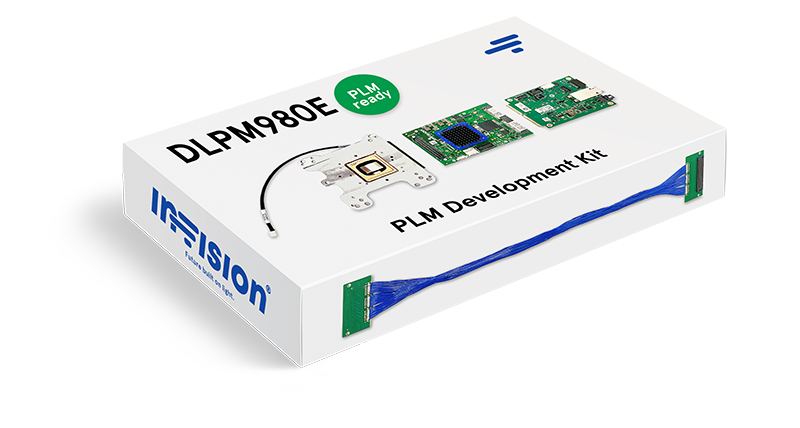
Start developing with the DLPM980VIS PLM Development Kit today!
Start developing with the Ultra-Resolution Programmable PLM Evaluation Kit.
Anyone working with modern laser optics, holography, or programmable illumination will eventually run into PLM. It sounds technical — and it is — but that’s exactly what makes it exciting: PLM enables precise, software-defined light control far beyond traditional DLP.
Phase Light Modulation (PLM) is a way to shape monochromatic light by controlling the phase of the wavefront pixel-by-pixel. Instead of turning pixels “on or off,” a PLM chip slightly delays or advances the reflected light at each pixel. Those tiny delays create a programmable phase pattern. When the phase-shaped light travels, the waves interfere with each other and form the desired intensity pattern at the image plane.
Texas Instruments’ PLM is a MEMS micromirror array derived from DLP technology, but operated in piston mode: each micromirror moves up and down in multiple discrete height levels to impose a controllable phase shift on the reflected beam.
In short:
PLM doesn’t directly “direct brightness.” It “directs phase,” and brightness appears through interference downstream.
DLP uses a tilting micromirror array. Each mirror flips between two angles to send light either into the optics (“on”) or away from them (“off”). That is amplitude modulation, controlling brightness by blocking/redirecting light.
PLM uses a similar MEMS mirror array, but with a crucial difference:
This changes what the device is good at:
In short:
DLP tilts mirrors to switch light on/off (amplitude control), while PLM moves mirrors up/down to set phase delays (phase-only control).
PLM is used when you want to not just control intensity distribution but also phase.
Key highlights are:
In short:
PLM enables efficient, high-speed, high-power software-defined beam shaping by redistributing light instead of wasting it.
Start developing with the Ultra-Resolution Programmable PLM Evaluation Kit.
PLM is best wherever a system needs laser-based, programmable light distributions rather than simple on/off pixels, including in more than one image plane.
In short:
Use PLM for programmable laser patterns like holography/CGH, beam steering, LiDAR/3D sensing, volumetric additive manufacturing and adaptive optics.